
Yes, the Ruffwear Front Range is one of the best everyday harnesses for Vizslas. The dual leash clips (front and back), lightweight padded build, and four-point adjustment system fit the breed’s lean deep-chested frame well. The main limitation is the over-the-head entry, which some dogs resist, and the neck strap can sit slightly loose on Vizslas with narrower necks until adjusted. Most Vizslas wear a Medium (22 to 27 inch chest girth) or Large (27 to 32 inch).
As an Amazon Associate I earn from qualifying purchases. Links marked (paid link) earn us a small commission at no extra cost to you.
The Ruffwear Front Range has been on the market long enough that every active dog owner has heard of it. For Vizslas specifically, the question is whether it actually fits and performs for a lean, deep-chested, high-energy breed that needs a harness for daily runs, field work, and off-leash recall training. I tested it across all three uses and here is what I found.
Ruffwear Front Range: At a Glance
- Best for: Daily walks, running, and light field work
- Material: 300-denier ripstop polyester with closed-cell foam padding
- Sizes: XS (13-17 in) through XXL (42+ in): Vizslas wear M or L
- Leash clips: Front chest clip (no-pull training) and back aluminum V-ring (running and everyday)
- Price range: $52 to $70 depending on size and color
- Our rating: 4.5 / 5
- Verdict: Recommended for Vizslas with chest girth 22 to 32 inches
Ruffwear Front Range All-Day Adventure Dog Harness
Dual leash clips, four-point adjustment, and lightweight padded build for daily walks, runs, and training. Sized M or L for most Vizslas.
Check Price on Amazon → (paid link)
Fit and Sizing on a Vizsla Build
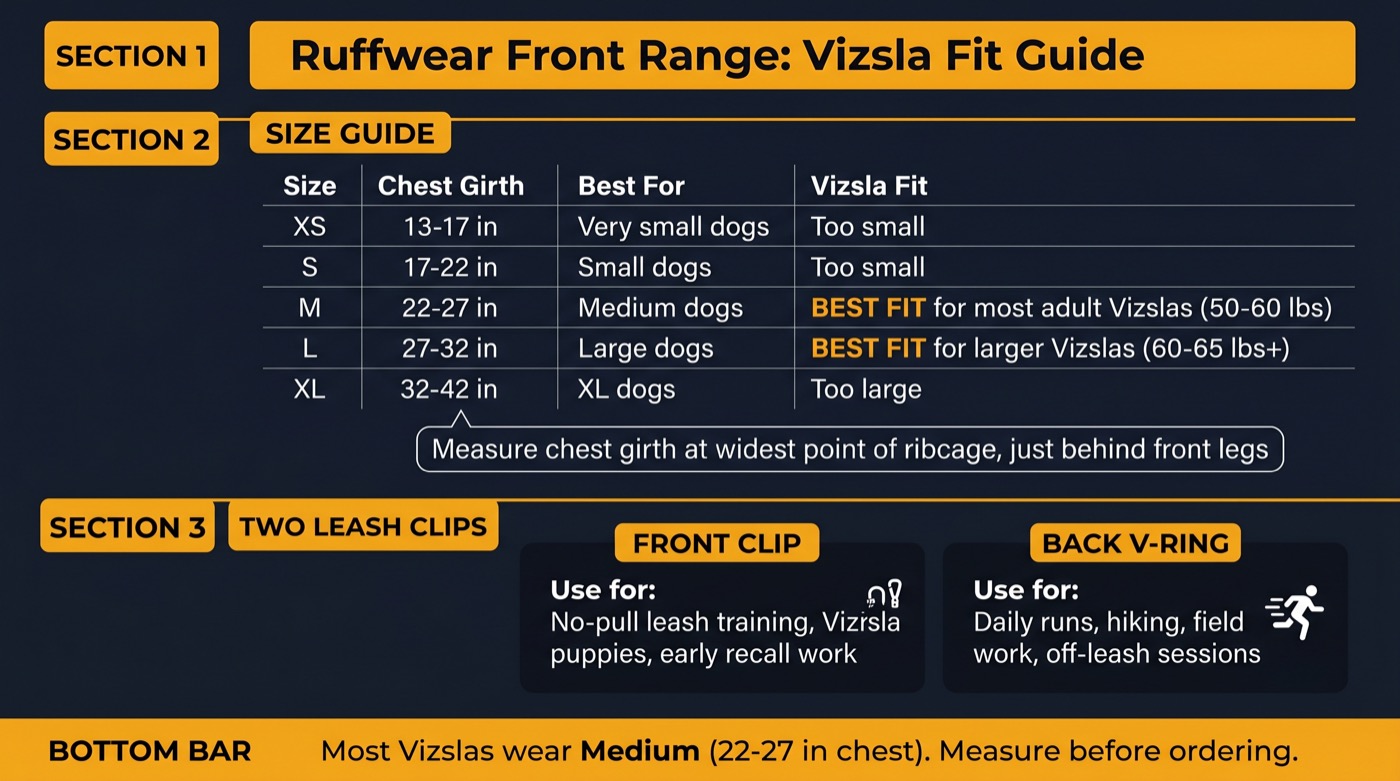
Vizslas are lean dogs with a deep chest, a narrower neck relative to their chest circumference, and an athletic build that sits somewhere between a medium and large frame. Most adult male Vizslas with a chest girth of 24 to 27 inches fit the Medium comfortably. Dogs measuring 26 to 29 inches typically sit on the border and may do better in the Large, particularly if they have a longer torso. Females tend to run half a size smaller.
The four adjustment points (two at the neck, two at the chest and belly) give enough range to dial in the fit on a lean dog without the harness gapping or shifting. The chest strap seats correctly behind the front legs at the widest point of the ribcage, which is where a Vizsla needs it to avoid restricting shoulder rotation during a run. The one area that consistently needs a tighter adjustment on this breed is the neck collar portion, which tends to sit slightly loose on a Vizsla’s narrower neck until you bring it in. It takes one adjustment the first time and stays put after that.
Running and Field Performance
For running, the back aluminum V-ring is the right attachment point. It sits centered between the shoulder blades and handles direct forward pull cleanly without twisting the harness sideways. On a Vizsla doing a five-mile run, the harness stays in position and does not migrate forward toward the shoulders or backward toward the hindquarters, which is a common failure point on cheaper alternatives. The ripstop polyester does not trap heat the way a neoprene or thick padded harness would, which matters for a breed that runs warm.
The front chest clip is effective for pre-run leash manners and early training work. When a Vizsla hits the end of the leash on the front clip, it redirects the dog sideways rather than allowing a full-force lunge forward. It is not a substitute for dedicated recall training, but as a management tool during the training phase it performs well. For field work and off-leash recall, most handlers switch to the back clip once the dog has reliable recall, as the front clip creates drag at speed that is unnecessary once the training goal is met.
Durability After Extended Use
Independent testing over five-plus years of daily use confirms that the Front Range holds up well. The stitching on the nylon webbing does not fray under regular pulling, and the buckle system, while it loosens slightly after six to twelve months of use, does not fail. The practical implication for Vizsla owners is that the harness needs a quick adjustment check every few months as it settles, particularly after the first few months of heavy use. The 2024 update added a plastic-coated front D-ring that resists abrasion better than the previous metal ring when the front clip is used regularly at pace.
What wears first is the padding compression under the chest strap, which flattens noticeably after twelve to eighteen months of daily use. It does not affect function, but owners who want maximum comfort padding for a senior dog or a dog with skin sensitivity will notice the difference after a year. The harness is machine-washable and dries quickly, which extends its effective life significantly compared to non-washable alternatives.
Ease of Daily Use
The over-the-head entry is the biggest practical friction point of this harness. The neck loop has to go over the dog’s head before the chest buckle clips into place. For a calm, cooperative Vizsla that is used to the routine, it takes about five seconds. For a puppy or a dog that has not been conditioned to head-entry equipment, the initial training period can take a week or two. If your dog has a strong aversion to anything going over their head, the Joyride Harness (step-in design) is a better starting point and avoids this issue entirely.
Once fitted, the single chest buckle clicks in and out cleanly for daily removal. The ID tag attachment on the back panel is a small but useful addition for owners who run in areas where a contact number on the harness is valuable.
Value for Money
At $52 to $70 depending on size, the Front Range is a mid-to-premium price point for a dog harness. For context, the Kurgo Journey Air runs $30 to $45 and the Joyride Harness runs $40 to $55. The price difference between the Front Range and its nearest competitors is justified by the durability record, the quality of the aluminum V-ring hardware, and the brand’s five-year field-tested track record. For a Vizsla owner who runs daily, the per-use cost over two or three years of a $65 Front Range works out lower than replacing a $35 budget harness every twelve months.
What We Liked
- Dual leash clips genuinely serve two different purposes, not a gimmick
- Four-point adjustment fits Vizsla’s deep-chested lean frame without gapping
- Lightweight and breathable for running in warm weather
- Durable: stitching and webbing hold up for years under daily use
- Machine-washable
What We Did Not Like
- Over-the-head entry requires conditioning for reluctant dogs
- Neck strap runs slightly loose on Vizslas until manually tightened on first use
- Chest padding compresses after twelve to eighteen months of heavy daily use
- Not crash-tested: not suitable as a vehicle restraint without a seatbelt adapter
How It Compares to Alternatives
vs. Joyride Harness: The Joyride uses a step-in vest design that wraps the full torso, which is more forgiving on very narrow-chested dogs and avoids the head-entry issue entirely. For intensive no-pull training it has better leverage. For running, the Front Range is lighter and creates less drag at speed. If your Vizsla resists head-entry or you are in early training, start with the Joyride and graduate to the Front Range for runs.
vs. Kurgo Journey Air: The Journey Air is lighter (around 6 oz vs the Front Range’s 8 to 10 oz) and has breathable mesh panels that perform better in summer heat. The Front Range is more durable and better padded for a dog that pulls hard or wears the harness eight or more hours a day. For a Vizsla in a warm climate used primarily for summer running, the Journey Air is a credible alternative at a lower price point.
Is the Ruffwear Front Range Right for Your Vizsla?
Buy it if: your Vizsla is used for daily runs or field work, you want a single harness that covers both training and running without swapping equipment, and your dog has no strong aversion to head-entry equipment.
Skip it if: your dog actively resists anything going over its head, you need a vehicle restraint harness (it is not crash-rated), or you are on a tight budget and your dog’s activity level is moderate (the Kurgo Journey Air covers the basics at half the price).
Consider the Joyride Harness instead if: you are in the early training phase with a Vizsla puppy, your dog has a very narrow neck relative to its chest, or you want a step-in design that does not require head entry.
Ruffwear Front Range All-Day Adventure Dog Harness
Tested for over five years by active dog owners. Recommended for Vizslas used for daily running, trail work, or field training.
Check Price on Amazon → (paid link)
Frequently Asked Questions
What size Ruffwear Front Range does a Vizsla need?
Most adult Vizslas wear a Medium (22 to 27 inch chest girth) or Large (27 to 32 inch). Measure your dog’s chest girth at the widest point of the ribcage, just behind the front legs. If your dog measures 26 to 27 inches, try the Medium first and size up to the Large if the neck strap cannot be tightened enough. Female Vizslas typically wear a Medium; larger males often need a Large.
Can I use the Ruffwear Front Range for running with my Vizsla?
Yes. Use the back aluminum V-ring for running, not the front chest clip. The back attachment handles forward pull cleanly and keeps the harness centered without shifting. The front clip is designed for training and leash manners, not sustained running pace.
Is the Ruffwear Front Range good for Vizsla puppies?
It works for puppies above 13 inches chest girth (XS size), but the over-the-head entry can be challenging to introduce to a young puppy. If your Vizsla puppy is in early socialization, a step-in harness like the PetSafe Easy Walk or the Joyride is easier to condition first. Transition to the Front Range once the puppy accepts equipment going over its head without resistance.
How do I stop the neck strap from being too loose on my Vizsla?
Vizslas have a narrower neck relative to their chest circumference, so the neck collar often needs to be tightened beyond the default setting. Use the two neck adjustment points to bring the collar snug enough that you can fit two fingers underneath but no more. Check it again after the first two weeks as the webbing settles slightly.
How long does the Ruffwear Front Range last?
With daily use, expect two to four years before the padding compresses noticeably. The webbing and stitching hold up considerably longer than the padding. Wash it every four to six weeks in a mesh laundry bag on a cold cycle and air dry. Inspect the buckle and adjustment sliders every three months and tighten as needed.
About the Author
Alex B. is a Vizsla owner and enthusiast who writes about the breed’s unique needs, personality, and care requirements. All advice is based on personal experience and research from veterinary and breed-specific sources.